What Should You Eat When Intermittent Fasting? A Plate-First Guide That Keeps Your Rice

Intermittent fasting changes when you eat, not what a good meal looks like. A 2026 Cochrane review of 22 trials found no clinically meaningful weight-loss advantage over ordinary dietary advice, so what is on your plate and whether fasting is safe for you matter more than the clock.
This guide covers which pattern to start with, what to eat and drink, how to break a fast, and who should skip it. It keeps rice on the plate, uses the Ministry of Health’s Isi Piringku plate as the base, and marks where the evidence is thin. A 2025 review of 13 trials in women also found time-restricted eating about as effective as cutting calories, not better.
It is written for adults in Indonesia who eat nasi and are weighing a fasting routine. If your real problem is a sleepy afternoon, that is a separate question. Read: why you get sleepy at 3 PM → the 3 PM article
Does intermittent fasting work better than eating normally?
Not by much, if at all. The 2026 Cochrane review found fasting no better than standard dietary advice for adults with overweight or obesity, and a 2025 review in women found it comparable to calorie restriction.
The Cochrane team pooled 22 trials with 1,995 adults. In the 21 studies that compared fasting with dietary advice, weight change was similar between groups. Against doing nothing, fasting groups lost about 5% of their starting weight and control groups about 2%, a gap the review authors did not consider clinically meaningful. Trials ran 6 to 12 months, so the review says little about keeping weight off.
Not everyone reads it the same way. Professor Leonie Heilbronn of Adelaide University told Scimex that pooling different fasting types was a mistake. She puts the gain at about 3.4% in the six “no intervention” studies, but says fasting matches continuous calorie restriction and that weight regain after about a year is common whatever the method.
The Frontiers in Nutrition review of 13 trials with 612 women says the same thing from another angle. Time-restricted eating lowered body weight overall, but when combined with calorie restriction it did not differ significantly from calorie restriction alone. Follow-up was short and most studies had moderate risk of bias.
Is intermittent fasting bad for my heart?
Probably not in the way the headline suggests. One conference abstract linked eating within 8 hours to 91% higher heart-death risk, but it was observational, based on two days of recalled eating, and outside experts said it supports no recommendation either way.
The analysis, reported by Smithsonian Magazine, used survey data on more than 20,000 US adults and has not been published in a peer-reviewed journal. Cardiologist Pam Taub called it a retrospective study drawing big conclusions from two days of data. Benjamin Horne noted that short eating windows can stem from health conditions, and the study did not record whether fasting was a choice. Penny Kris-Etherton of the American Heart Association’s nutrition committee suggested people might consider pausing intermittent fasting until more is known, so if you have heart disease, ask your doctor before starting.
Which pattern should I start with: 12:12, 16:8 or 5:2?
Start with a 12-hour overnight gap, such as 7 pm to 7 am, and lengthen it only if it feels easy. No pattern has been shown to beat the others, so choose the one that fits your work hours and sleep.
detikHealth describes the 12-hour fast as a good starting point for beginners, since part of the fast is spent asleep. The 16:8 pattern means eating inside an eight-hour window, for example noon to 8 pm, and Harvard Health calls it one of the most popular approaches. The 5:2 pattern means eating normally on five days and sharply cutting calories on two non-consecutive days. The same detikHealth piece gives roughly 600 calories for men and 500 for women on those days, without naming a source for the figures.
Fimela suggests example 16:8 windows such as 07:00 to 15:00, 09:00 to 17:00, 12:00 to 20:00 or 14:00 to 22:00, and says there is no fixed rule, so you can adjust to work, sleep and energy. For an office worker who eats lunch with colleagues, a 10:00 to 18:00 or noon to 8 pm window keeps the social meal. The research cannot name a best pattern. The Cochrane review lumped alternate-day, periodic and time-restricted fasting together, which Professor Heilbronn criticised, so its results cannot be split by pattern.
What should I eat in my eating window?
Build each meal on the Isi Piringku plate: about a third vegetables, a third staple, a sixth protein and a sixth fruit. The same plate works inside or outside a fasting window.
The fractions are worked out from the Ministry of Health’s printed plate, so treat them as a visual guide and not a measured portion. Mahmud Aditya Rifqi, deputy dean of UNAIR’s Faculty of Public Health, gives the same principle for fasting in plain terms: varied, nutritious and balanced food, with plenty of high-fiber vegetables and fruit to stay full longer. He adds that broth-based dishes such as soto help with fluid needs. ZOE’s guide says there are technically no food restrictions outside the fast, and suggests whole grains, vegetables, lean protein and high-fiber, high-protein foods to feel fuller.
A shorter eating window leaves fewer meals to work with. The national guideline Permenkes 41/2014 recommends 400 to 600 grams of vegetables and fruit a day, which takes planning when you eat twice instead of three times. A vegetable dish and a piece of fruit in each meal is the simplest way to get there.
Can I still eat rice while intermittent fasting?
Yes, none of the reviews cited in this guide tested rice or asked participants to give it up. The Isi Piringku plate keeps a staple at about one-third of the plate, so judge your portion by plate share, not by the scale.
Permenkes 41/2014 counts one portion of rice as 100 grams, about three-quarters of a cup, and sets no limit per meal. If you have diabetes or another condition with carbohydrate targets, follow the numbers your doctor or dietitian gave you. Read: keeping rice on the plate → the rice-friendly lunch guide
Disclosure: NADI Labs, the publisher of this article, makes NADI Elyxir CARBLOC, a 30 ml fermented botanical shot taken about 15 minutes before a carb-heavy meal. It contains mulberry leaf extract, white kidney bean extract, vitamin C and mulberry fruit juice, and it is made for people who want to keep eating rice. None of the studies linked in this article tested CARBLOC or any carb blocker, so this article makes no claim about it. [CARBLOC product page]
What can I drink while fasting, and what breaks a fast?
Water and unsweetened black coffee or tea are generally accepted during a fast, and anything with calories breaks it. Sweetened drinks such as teh manis and kopi susu with sugar end the fast.
UNAIR’s Mahmud explains that, unlike Ramadan fasting, intermittent fasting still allows water and zero-calorie drinks such as coffee without sugar. ZOE’s guide takes the same line: water, plus unsweetened black coffee and tea, with any calories breaking the fast. Fluids matter on a fast day. HealthXchange.sg, run by SingHealth, advises at least eight cups of water a day.
The gray areas are milk and sweeteners. ZOE says a small splash of milk generally does not raise blood glucose, but that claim rests on its own unpublished data, so treat it as an opinion and not a finding. ZOE also advises avoiding artificial sweeteners during the fast because they may affect blood sugar.
Drink or food | Breaks the fast? | Basis |
|---|---|---|
Water | No | |
Black coffee, unsweetened tea | No | |
Teh manis, kopi susu with sugar | Yes, they contain calories | |
A splash of milk | Disputed; ZOE says it is usually fine, based on unpublished data | |
Artificial sweeteners | Disputed; ZOE advises avoiding them | |
Any food | Yes |
What should I eat first to break a fast?
No source reviewed for this guide cites a trial showing a best first food. The advice that holds up is a balanced main meal, eaten without overdoing it.
UNAIR’s Mahmud, writing about opening a fast, recommends one main meal, then a healthy snack later, and avoiding a large amount of food in a short time. Fimela’s beginner guide says to stop eating before you feel too full, and HealthXchange.sg warns against overeating or binge-eating in the eating period.
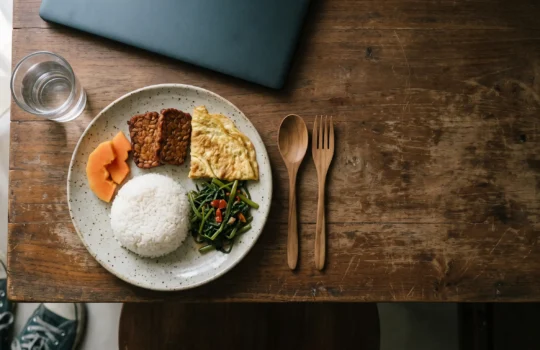
Some pages go further. Superpower says a high-sugar first meal often triggers reactive hypoglycemia within an hour, but gives no study for it, so treat that as an unproven claim. If you want a simple rule, use the plate from earlier: vegetables, a protein such as tempe, egg or fish, and a moderate scoop of rice, with water first. That rule is this guide’s suggestion based on the Isi Piringku proportions, not a research result.
How do I handle hunger, headaches and overeating?
Hunger and headaches were the minor side effects reported in some trials, and they resolved on their own. Cut calories gradually, drink enough fluid, and stop if you feel unwell.
In the Frontiers in Nutrition review of women, only four of 13 trials documented adverse events, and those were minor and self-resolving, such as hunger and headache. The authors note that this thin reporting limits what can be said about safety.
On how much to cut, UNAIR’s Mahmud advises reducing intake gradually, by about 300 to 500 kcal from daily needs, and never below the body’s minimum needs. He warns that a deficit that persists can lead the body to use muscle protein for energy. He also recommends at least eight glasses of fluid a day and plenty of high-fiber vegetables and fruit to stay full.
HealthXchange.sg adds three limits: do not fast for more than 24 hours, do not overexert yourself while fasting, and stop fasting and seek medical help if you feel unwell. Hard exercise on an empty stomach is the situation to watch. If hunger leads you to overeat when the window opens, the window may be too short for your routine, and a longer one is a reasonable adjustment.
Will intermittent fasting cost me muscle?
A sustained calorie deficit can cost muscle, with or without fasting. In the 2025 review of women, lean mass was not reduced, but the trials were short.
UNAIR’s Mahmud warns that when intake stays below the body’s minimum needs, the body can use muscle protein for energy and muscle mass falls. The risk comes from the size of the deficit. The Frontiers review found no significant change in fat-free mass or lean mass with time-restricted eating, and it called for longer trials to judge long-term effects.
The heart-risk abstract raised the question from the other side. Its co-author Victor Zhong suggested that lower lean muscle mass in the shortest-window group might explain the link, citing separate research. That is a hypothesis, not a finding. Keeping protein in each meal, as the plate does with its sixth of fish, egg, tempe or tofu, is a sensible precaution.
Who should not try intermittent fasting?
Several groups should avoid it or ask a doctor first. They include pregnant or breastfeeding women, people with diabetes on insulin or similar drugs, those with kidney or liver disease or an eating-disorder history, and adolescents.
HealthXchange.sg, written with an endocrinologist and a dietitian from Singapore General Hospital, says fasting is not safe for everyone. Its list of people who should not do it covers pregnant or breastfeeding women, patients with kidney problems or liver cirrhosis, people with low blood pressure or nutritional deficiencies, people with diabetes on insulin or drugs that can cause low blood sugar, and people with a history of eating disorders. Anyone with another medical condition or on regular medication should speak to a doctor first.
A Dietitians Australia page peer reviewed in April 2022 adds underweight people and adolescents, and says people on diabetes medication or in active cancer treatment should get medical advice because of the risk of low blood sugar. It also notes that fasting does not appear to outperform other calorie-reducing diets. The page does not name its publisher, so check it against your own doctor’s advice.
One more limit applies to every study in this guide. The Cochrane authors say the results cannot be extrapolated to the whole population, since effects may vary by sex, age, ethnicity, disease status or eating disorders, and most trials enrolled predominantly white participants from high-income countries. The 22 trials also came from North America, Europe, China, Australia and South America, so none was run in Indonesia.
Is intermittent fasting the same as fasting for Ramadan?
No. Ramadan fasting is worship, lasts about 13 to 14 hours in Indonesia and allows no food or drink, while intermittent fasting is a health tool that permits water and unsweetened coffee.
UNAIR’s Mahmud sets out the differences in a UNAIR news piece published on 18 February 2026. Ramadan fasting runs from sahur to iftar, and its main purpose is devotion. Intermittent fasting is usually chosen for health goals such as weight control, comes in many patterns (16:8, 5:2, eat stop eat, one meal a day) and lets you drink water and calorie-free drinks during the fast.
The eating advice overlaps, though. For Ramadan he recommends varied, balanced meals, a sufficient sahur, and at least eight glasses of fluid split across iftar, the evening and sahur, with fiber-rich vegetables and fruit to stay full longer. Broth dishes like soto help with fluids. If you already fast during Ramadan, that month is not a trial run of intermittent fasting, because the rules and the reasons differ. Read: why the fasting hours feel sleepy → the 3 PM
Which parts of a fasting plan have evidence behind them?
Little of a fasting plan has been shown to beat simply eating a bit less. What holds up is a balanced plate, a gradual calorie cut, enough fluid, and checking whether fasting is safe for you.
The weight-loss evidence is the weakest link: the Cochrane review and the Frontiers review both put fasting on par with ordinary calorie control, and Dietitians Australia says most behavioral weight-loss methods, fasting included, lead to short-term loss followed by regain. If a fasting window makes eating well easier for you, that is a fair reason to use it. If it makes you tired, hungry or anxious about food, a regular three-meal day on the Isi Piringku plate is just as defensible.
Start with a 12-hour gap, keep the plate and your rice, drink water, and talk to a doctor if any of the groups in the safety section applies to you. This article is general information, not medical advice. NADI Elyxir CARBLOC is not part of the evidence above; see [CARBLOC product page] if you want to know what it is.
FAQ
Is 16:8 better than a 12-hour fast?
No study cited here shows that it is. The Cochrane review pooled different fasting types, which Professor Heilbronn criticised, so it cannot rank them.
Does black coffee break my fast?
Not if it has no sugar, according to UNAIR’s Mahmud. Sweetened drinks such as teh manis do break it, and milk is a gray area.
Do I need to count calories?
Not necessarily, but the gap between what you eat and what you need still drives weight change. UNAIR suggests cutting about 300 to 500 kcal gradually and never going below your minimum needs.
Can I fast if I take medication?
Ask your doctor first, especially if you take insulin or diabetes drugs that can cause low blood sugar. Dietitians Australia gives the same warning.